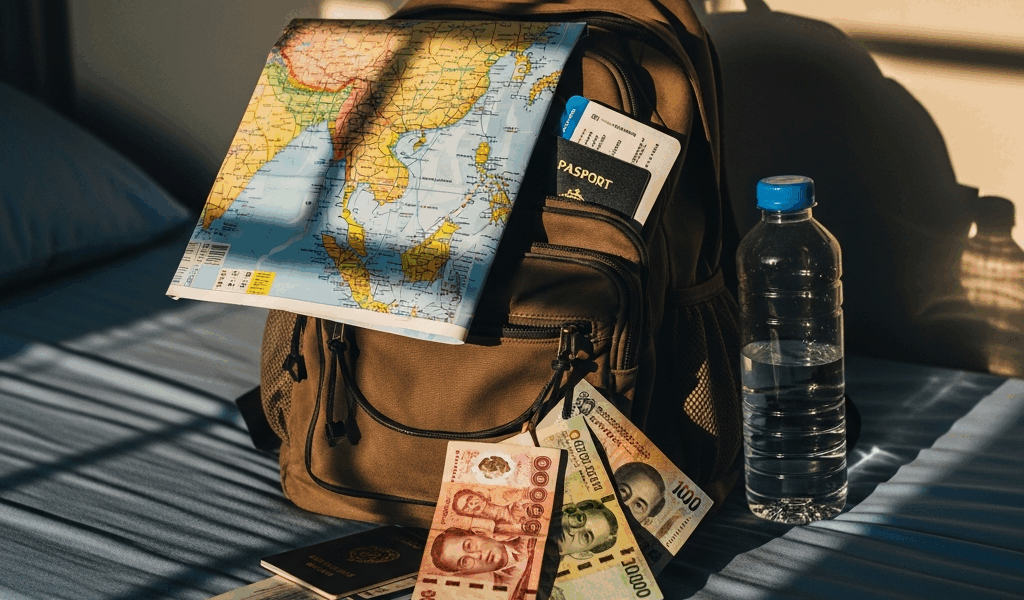
Backpacking Southeast Asia on a budget has gotten complicated with all the outdated pricing guides flying around. Most of what’s online is from 2023 or 2024—ancient history at this point. My five-week run from Bangkok to Bali last month ran me roughly $2,100 total. About $300 per week when you factor in the inter-country flights. That’s a real number pulled from my actual bank statements, not some estimate cobbled together from old blog posts.
As someone who just finished this exact route, I learned everything there is to know about what Southeast Asia actually costs in 2026. The planning wasn’t the hard part. Figuring out what things genuinely cost right now—that was the nightmare. Inflation has hit this region unevenly. Some prices barely moved. Others, especially anywhere tourists cluster, jumped hard. I paid way too much for a speedboat tour in Krabi I didn’t even enjoy. I also skipped a cooking class in Bangkok that would have been genuinely incredible. Don’t make my mistake.
Here’s what came out of my bank account, city by city, with the actual numbers.
The 2026 Budget Reality — What Southeast Asia Actually Costs Now
Thailand: The Gateway
Bangkok in January 2026 was hot, humid, and pricier than anything I’d read suggested. A dorm bed near Khao San Road ran 350 baht per night—around $10 USD. Honestly, I should have gone further from the tourist zone immediately. The same quality bed was sitting at 200 baht in smaller neighborhoods outside the center.
Food swung wildly depending on where I ate. Street carts were legitimately cheap—pad thai for 40 baht, satay skewers for 60, fresh mango with sticky rice for 50. I ate those combinations multiple times daily and never cracked $4 in a 24-hour period. The second I sat down somewhere with an English menu and ambient lighting, prices jumped to 250–400 baht for identical dishes. Learned that one fast.
The BTS Skytrain handled most of my city movement—15 to 65 baht per trip depending on distance. I grabbed a rechargeable Rabbit card and loaded it with 500 baht, which lasted roughly four days of moderate exploring. Simple system, works well.
Here’s the daily breakdown I actually tracked:
- Hostel: 350 baht ($10)
- Food (street stalls and local spots): 150–200 baht ($4.50–6)
- Transport: 100 baht ($3)
- Activities: 300–500 baht ($9–15) on days involving the Grand Palace or a Muay Thai class
My daily Bangkok average landed around $23–28. Some days hit $18. Some days hit $40 when I treated myself to a proper dinner or a massage—which, for the record, remains criminally affordable at 300–400 baht per hour. Honest accounting means including all of it.
From Bangkok, a bus to Krabi cost 450 baht ($13) for an eight-hour ride with a decent tour company. VIP sleeper coaches were available for double that. The standard bus was fine—I slept most of the way anyway.
Southern Thailand: Islands and Reality Checks
Krabi, Phi Phi, Railay, Phuket—this stretch is where I made my biggest budgeting mistakes and learned my most useful lessons. Both things at once, apparently.
Island hopping tours sound like highway robbery when you first read the prices: 800–1,200 baht ($24–36) for a full-day speedboat tour with snorkeling and lunch included. But what is an island tour here? In essence, it’s a full-day guided experience across multiple islands with gear and food included. But it’s much more than that—it’s genuinely the fastest way to meet other travelers. The coral was insane, the boat was fast, and I ended up spending three evenings with people from Australia and Germany I’d never have crossed paths with otherwise. This was the splurge that actually paid off.
What wasn’t worth it: the seafood restaurant right on the Ao Nang waterfront. I paid 500 baht ($15) for pad krapow gai that cost 80 baht two blocks inland. Same dish. Probably the same kitchen supplier, honestly. The view was nice. It was not a $13-difference nice view.
Accommodation across the island towns ranged from 250 baht ($7.50) for a basic fan room in a shared guesthouse to 800 baht ($24) for a private AC bungalow. I mostly stayed in the 300–400 baht fan room range—totally adequate. The one night I upgraded to a private AC room, I didn’t sleep better. I just felt cooler. Worth knowing before you book.
Daily average in the Krabi area: $27–32, inflated by that island tour and some beers I can’t quite justify in retrospect.
Vietnam: The Budget Sweet Spot
A Nok Air flight from Phuket to Hanoi ran 1,200 baht ($36). Budget airlines in Southeast Asia are legitimately functional—not comfortable, but functional. The plane got me there.
Vietnam is where the whole budget framework started making real sense. Hanoi and Ho Chi Minh City aren’t as saturated with backpacker infrastructure as Bangkok—at least not in the neighborhoods I spent time in. Dorm beds in Old Quarter hostels ran 150,000 VND ($6) on the low end, 250,000 VND ($10) for places with reliable wifi and actual hot water.
The food situation was extraordinary. I ate better in Vietnam than anywhere else on this entire trip and spent less money doing it. A proper pho broth with beef from a street vendor cost 25,000–35,000 VND—that’s $1 to $1.40. Banh mi sandwiches. Spring rolls. Vermicelli bowls. I genuinely could not locate a meal over 50,000 VND ($2) unless I wandered into somewhere obviously designed for Western tourists. I never did that.
Specific prices from my actual notes:
- Pho: 30,000 VND ($1.20)
- Banh mi: 20,000 VND (80 cents)
- Fresh coconut juice, served in the actual coconut: 15,000 VND (60 cents)
- Local Saigon beer: 10,000 VND (40 cents)
- Motorbike taxi across Hanoi: 20,000–30,000 VND ($0.80–1.20)
My daily budget in Vietnam dropped to $16–20—even with paid activities factored in. A cooking class in Hanoi cost 400,000 VND ($16) and was absolutely worth every dong. A day trip to Ha Long Bay ran 1.2 million VND ($48) and turned out to be one of the best single days of the entire five weeks. That’s what makes Vietnam endearing to us budget travelers—the math just works even when you splurge.
The language barrier was the actual challenge, not the cost. Google Translate and hostel staff handled most navigation questions. That system worked fine.
Cambodia: Criminally Affordable
An overnight bus from Ho Chi Minh City to Phnom Penh cost 120,000 VND ($4.80) standard. I upgraded to the VIP sleeper version for 250,000 VND ($10)—and slept properly for the first time in days. Smart move.
Cambodia was cheaper than Vietnam. Dorm beds in Siem Reap and Phnom Penh ran 25,000–40,000 KHR ($6–10). Street food sat at 1,000–3,000 KHR—that’s 25 to 75 cents. A full plate of rice with curry at a local restaurant cost 8,000–15,000 KHR ($2–3.50).
I split two weeks between Phnom Penh—four days, mostly the museums and riverfront—and Siem Reap, nine days, almost entirely focused on the Angkor temple complex. The three-day Angkor pass costs $62 USD flat. Probably should have opened with this section, honestly, because that’s the one fixed cost that catches people off guard. Spread across three days it hurts less. The temples were worth every cent regardless—seeing Angkor Wat at sunrise rewires something in how you understand human history and scale. Not exaggerating.
Outside that temple pass, my daily Cambodian average was $11–14. The cheapest sustained stretch of the entire trip.
Laos: Time Slowed Down
Getting from Siem Reap to Vientiane involved a bus through the Tonle Sap region, a Thai border crossing, and another bus north—roughly 300,000 VND plus 1,000 Thai baht in border paperwork fees. Call it $18 total for a 14-hour journey. The logistics were annoying. Worth it anyway.
Laos felt like 2015 in some specific, hard-to-define way. Fewer tourists, less anglicized infrastructure, less of the polished backpacker-trail machinery that makes Thailand and Vietnam feel sometimes too smooth. That’s what makes Laos endearing to us travelers who want something slightly unfiltered—it’s cheaper and more genuine, though you need to tolerate more logistical friction.
Vientiane dorm beds: 60,000–80,000 LAK ($5.50–7.50). Luang Prabang ran slightly higher at 70,000–90,000 LAK ($6.50–8.50). Full meals at local restaurants cost 20,000–40,000 LAK ($1.80–3.50). The Luang Prabang night market had grilled fish, sticky rice, and vegetables for 25,000 LAK—$2.25. I ate there every single night, no regrets.
Five days in Vientiane exploring temples and the Mekong riverside, then six days in Luang Prabang—monasteries, the night market, tubing on the river. That tubing trip cost 80,000 LAK ($7.25) and turned out to be a strange, slightly sketchy, completely unforgettable few hours. Absolutely worth it.
Daily average in Laos: $12–16. Second cheapest country overall, right behind Cambodia.
Indonesia: The Final Push
Flying back through Bangkok as a hub, I caught a budget flight to Denpasar, Bali for 1,500 baht ($45). Five hours. I arrived exhausted and grateful the transport phase was nearly finished.
Bali in 2026 has gotten noticeably more expensive—apparently this has been a consistent trend since the post-pandemic tourism surge, and it hasn’t reversed. Dorm beds in Seminyak and Kuta run 100,000–200,000 IDR ($6.50–13). Beachside locations charge accordingly. I stayed further inland in Ubud—80,000–120,000 IDR ($5–8) for a decent dorm bed, noticeably more manageable.
Food costs more here than anywhere else on the route, though still well below Western tourist destination prices. Local warungs—family-run spots, usually a few plastic tables, handwritten menus—served rice with vegetable curry and chicken for 25,000–40,000 IDR ($1.60–2.60). Tourist-adjacent restaurants charged 80,000–150,000 IDR ($5–10) for effectively the same plate. Learning to identify the difference takes about one afternoon. Eat at warungs exclusively and the numbers stay manageable.
[X] might be the best option for accommodation, as Bali requires distance from the tourist corridors. That is because the price differential between Seminyak and Ubud for identical quality beds runs nearly 40%—and Ubud is genuinely more interesting anyway.
My daily Bali budget ran $18–24, slightly inflated by activities—rice terrace trekking cost 150,000 IDR ($10) plus a guide tip, and a few other excursions pushed certain days higher. Still the most expensive sustained stretch outside the inter-country flights themselves.



Stay in the loop
Get the latest jet set travel tips updates delivered to your inbox.