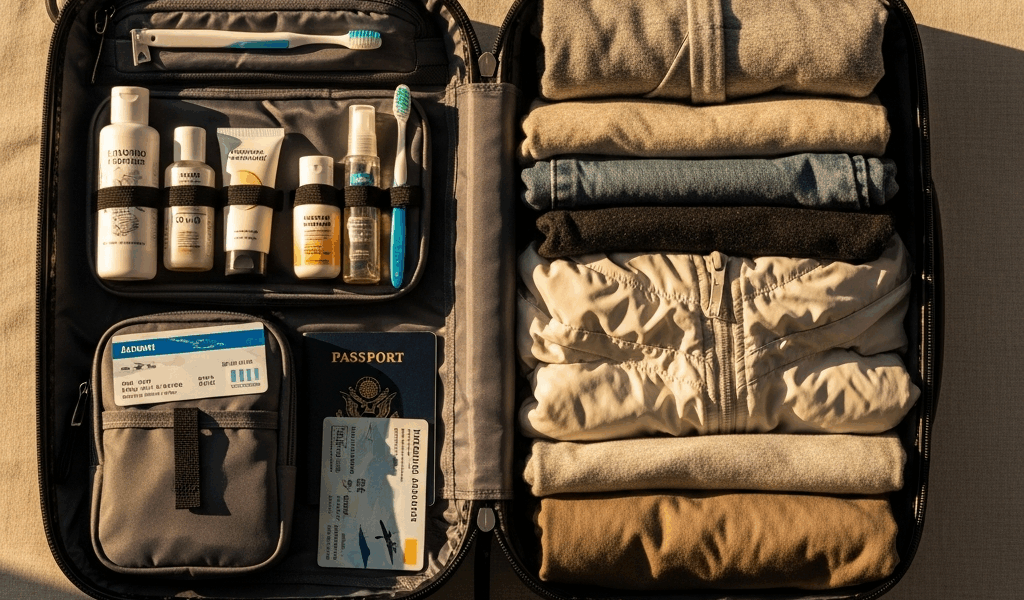
Why Checked Bag Fees Are So Easy to Avoid
Checked bag fees have gotten complicated with all the fine print flying around. Basic economy this, companion rules that — most travelers just pay the $35 and move on. But here’s the thing: a huge chunk of those fees were completely avoidable.
As someone who once paid $35 to check a carry-on-sized bag on a United flight from Denver to Chicago, I learned everything there is to know about this subject. The woman seated next to me didn’t pay a cent. Same airline, same flight, same bag. She had status. I didn’t. That was the last time I flew without knowing exactly what benefits I had.
Today, I will share it all with you. Credit cards, fare classes, loyalty tiers, status matches — the levers exist everywhere. The problem isn’t that airlines hide these benefits, exactly. It’s that they’re buried in cardholder agreements, scattered across loyalty tiers, and nobody bothers to put them together in one place you can actually use before checkout. So, without further ado, let’s dive in.
Use the Right Credit Card Before You Book
Co-branded airline cards are the fastest fix — no status required. But most people either pick the wrong card or don’t realize what they’ve already got sitting in their wallet.
The Cards That Actually Cover Bags
The Delta SkyMiles American Express card includes one free checked bag for you and companions on the same reservation. The United Explorer Card does the same, though with a twist — the Explorer covers up to eight companions on a single reservation. A family of nine flying together with zero bag fees. That’s real money.
Southwest’s Rapid Rewards card gives two free bags on every flight. That’s also just Southwest’s standard policy, so it’s less a hidden perk and more a baseline. The American Airlines Citi AAdvantage card mirrors Delta and United — cardholder plus companions, one free bag each.
Here’s what most people miss: you must book the flight using that card. Not just own it. Not just carry it. Swipe it at checkout. American and Delta are especially strict about this. I’ve seen people show up at the bag drop waving their Explorer Card at an agent — card not used to book the flight, benefit doesn’t apply. Don’t make my mistake.
Chase Sapphire Preferred and Amex Platinum do not cover checked bags as a primary benefit. I’m apparently a slow learner because I assumed they did for an embarrassing amount of time — Sapphire works for me for other travel perks, but free bags never showed up once. Know what your card actually covers before you assume.
Companion Rules and Reservation Structure
Most co-branded cards extend free bags to companions, but only under one booking confirmation. Separate reservations mean your travel partner is on their own. United is the most generous here — the Explorer Card covers a wide companion definition, and their “same reservation” rule is applied broadly. Delta and American want everyone ticketed together under one confirmation number. Book accordingly.
Book the Right Fare Class or Bundle
Fare class is the second-order lever. Airlines price basic economy lower specifically by stripping benefits — and bags are usually the first to go.
Basic Economy vs. Standard Economy
United basic economy: no free checked bag. Standard economy: one included. Delta basic economy: same story, no bag. American basic economy strips the checked bag but still allows a carry-on and personal item — slightly better, still not great.
Southwest breaks the mold entirely. Two free checked bags on every fare type, no exceptions. If you’re weighing Southwest against any legacy carrier and bag fees are a factor, that’s a $70 round-trip difference right there.
Here’s math worth running. Say United basic economy costs $180 and standard economy costs $210. Add one checked bag each way at $35 — that’s $70 in fees on top of $180, bringing basic economy to $250 total. Standard economy is $210. You’re actually losing money on the “cheaper” ticket. A lot of travelers never run this calculation.
Bundles and Fare Packages
Airlines also sell fare bundles that roll a checked bag into the price alongside seat selection and priority boarding. United’s Economy Plus bundle, for example, might run $60 above basic economy. If you were going to pay $70 in bag fees anyway, the bundle is mathematically better and throws in seat selection as a bonus.
Most booking pages now show the à la carte total right at checkout. Add everything up before you commit. Bundles beat à la carte fees more often than people expect — at least if you were planning to check a bag regardless.
Airline Loyalty Status and Hidden Free Bag Rules
Probably should have opened with this section, honestly. Status is the most underrated tool here because even entry-level elite tiers include free checked bags on most major carriers — and most travelers think status is out of reach.
Status Thresholds and Bag Eligibility
United Silver Elite — the first paid tier — includes one free checked bag for you and up to eight companions. You don’t need Gold or Platinum. Silver does it. Delta SkyMiles Silver Medallion: same deal. American Airlines AAdvantage Bronze Elite: also included.
These aren’t aspirational goals. They’re achievable for anyone who flies a handful of times a year. United Silver requires 25 segments or 30,000 miles in a calendar year. Roughly six round trips. That’s not a road warrior schedule — that’s a moderately busy traveler.
Status Matches and Fast-Track Challenges
But what is a status match? In essence, it’s when a carrier matches your existing elite tier from another airline to a comparable tier on their program. But it’s much more than a simple swap — it hands you benefits immediately, with zero flight history on the new airline required.
Hold Alaska Airlines Gold? You might match into Delta Gold Medallion and walk away with free bags on your next flight. The process usually requires a phone call and proof of current status. Twenty minutes, maybe. I’ve done it three times with different airlines over the years — twice it worked on the first try.
There’s also the status challenge route. Some airlines let you earn status by hitting a segment target in a 90-day window. If a trip is already coming up, a challenge can lock in bag benefits for that trip and carry them forward into the next year. Worth a call to ask.
Last-Resort Tricks If You Have No Status or Card
One-off trip. No co-branded card. No status. You still have options — less elegant ones, but they exist.
Prepay Online and Consider Luggage Shipping
Prepaying a checked bag online usually runs $30–35. Paying at the airport jumps to $40–50. It’s not a loophole, but it’s $10–15 saved if you already know a bag is coming with you.
For longer trips or multiple bags, services like Ship Sticks or Luggage Forward ship your bag ahead to your destination. A bag sent via Ship Sticks from Los Angeles to New York runs roughly $65–80 and arrives in 4–6 business days. Checking two bags on a premium carrier and paying fees both ways? That math gets close fast.
That said, this only works with lead time. Spontaneous trip booked 48 hours out — forget it. Week-plus of runway with two heavy bags? Run the numbers.
The Personal Item Loophole
Every airline allows one personal item free. Definition varies. I’ve watched gate agents wave through 40-liter Osprey packs without a second glance. I’ve also watched agents reject bags that seemed completely reasonable. There’s no reliable formula here — it depends on the agent, the flight load, and frankly the day.
Don’t build your travel strategy around this. If you’re packing light enough to genuinely fit everything in a tight personal item plus a carry-on, great — you’ve eliminated bag fees without any tricks. But it’s not a plan. It’s a maybe.
The Real Math on Credit Cards
Fly more than four times a year with checked luggage? You’re probably paying $280 or more annually in bag fees alone — assuming one bag each way at $35. Most co-branded airline cards run $95–150 a year. The card pays for itself on bags before you even count the points.
That’s what makes this calculation endearing to us frequent travelers: it’s not complicated. Annual card fee versus annual bag fees. The card wins at four-plus round trips. Every time.
Figure out which airline you use most. Get their co-branded card. Book every flight with it. That’s the whole system. You won’t think about checked bag fees again.

Stay in the loop
Get the latest jet set travel tips updates delivered to your inbox.