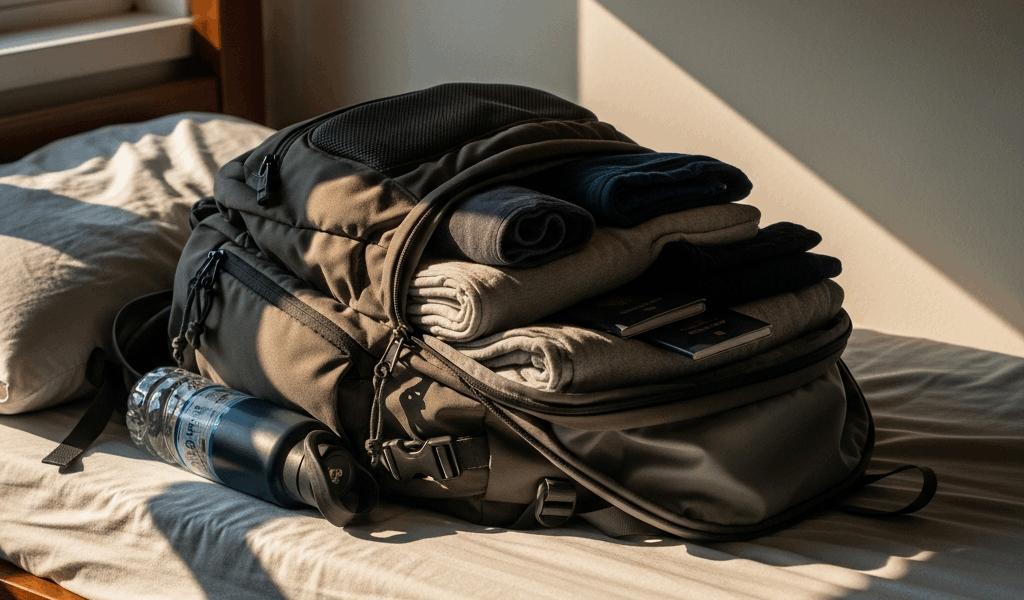
What Makes the Synik Different from Every Other Travel Bag
Travel bag reviews have gotten complicated with all the sponsored content and affiliate noise flying around. As someone who has dragged the Tom Bihn Synik 30 through Southeast Asia, across Europe in winter, and on more domestic flights than I care to count, I learned everything there is to know about this bag the hard way. Today, I will share it all with you.
The short version: it’s different. Just not in the ways most reviews bother to explain.
First thing you notice is the clamshell opening. Traditional backpacks make you dig into a dark hole hoping your shirt isn’t at the bottom — the Synik opens completely flat. Pack everything, see everything, grab anything. Sounds trivial. It genuinely isn’t. I borrowed a friend’s Osprey Farpoint for a weekend trip and found myself annoyed within the first hour. That was when I understood what I’d been taking for granted.
The laptop compartment sits flush against your back, padded with Tom Bihn’s AirScape foam. My 14-inch MacBook Pro slides in with maybe a millimeter clearance on each side. The padding is substantial without being bulky — and I’ve never once flinched handing this bag to an airport baggage handler, which says everything. Those people have no mercy.
Water bottle pockets run down both sides. Left and right. They’re not some stitched-on afterthought — they’re engineered to actually grip a full 32-ounce Hydro Flask without it shifting mid-stride. I tested this aggressively in Barcelona during a six-hour walk in 90-degree heat. The bottle stayed put. Nothing leaked. Small detail that compounds over thousands of miles.
The interior organization panel is where Tom Bihn’s obsessive reputation becomes visible. Cables in one section. Toiletries in another. Underwear and socks in a third. I’m apparently a naturally disorganized person — my home desk looks like a small disaster — and yet this bag forces a kind of order on you that actually sticks. That’s what makes the Synik endearing to us chaotic packers.
Built-in compression straps cross the main opening. Pull tight and a stuffed bag becomes compact. Leave loose and you have breathing room. The stitching on those straps is — and I’m not exaggerating here — uniform to the point of looking machine-perfect. I’ve examined it up close more than once. Every stitch. The quality gap between Tom Bihn and cheaper brands stops being abstract the moment you actually look.
How It Performs on Actual Trips
Specs mean almost nothing until you live with a bag for two years. So, without further ado, let’s dive in to what actually happens out there.
Carry-on compliance is real and consistent. The Synik 30 measures 19 x 12 x 9 inches. I’ve flown it on Southwest, United, Delta, JetBlue, and European carriers including Ryanair — notorious for enforcing tight size restrictions with what feels like personal satisfaction. Every single time, overhead bin. No gate-check. No argument. I once watched a guy behind me get stopped and forced to check his bag while I walked straight onto the plane. Don’t make my mistake of ever going back to a bag that doesn’t fit.
Packing capacity surprised me early on. Thirty liters sounds small until you roll everything properly and use the compression system. Eight days of clothes, toiletries, a laptop, two chargers, and a portable battery. Two weeks? Maybe. Comfortably? No. But the 30L rating is honest, which in a market full of inflated numbers feels almost radical.
Comfort over long walks tested the bag in ways I hadn’t anticipated. Seven hours through Rome with the Synik fully loaded — the hip belt moved weight off my shoulders, the padded straps didn’t dig in, and my back stayed dry from the ventilated panel. I’ve worn bags that felt fine in the first hour and genuinely painful by hour three. This was not that.
Probably should have opened with this section, honestly. The harness system is where most travel bags quietly fail. Bad straps ruin trips. The Synik’s straps stay put, the hip belt functions like a hip belt is supposed to, and nothing cuts circulation after extended wear. I’ve recommended this bag to four people specifically because of the harness. All four still use it.
Organization panels proved useful in ways I didn’t expect. Dirty laundry separated from clean clothes. Laptop away from a leaky toiletry bag. Cables untangled. Landing in a new city at 11 PM and knowing exactly which compartment holds my phone charger — that’s not a small thing when you’re exhausted and the hotel wifi isn’t working.
Weather resistance is genuine but not absolute. The fabric sheds light rain immediately. I got caught in a serious downpour in Prague — everything inside stayed dry. Heavy rain with sustained wind might be a different story. Tom Bihn doesn’t claim waterproof, and I appreciate that they didn’t oversell it.
The Price Problem — Is $300+ Justified
The Synik 30 retails for $315. For a backpack, that’s steep. For a 30-liter backpack, some people hear that number and immediately close the tab.
But here’s how it actually compares against bags people genuinely consider. The Osprey Farpoint 40 runs around $180. Lighter, slightly more capacity — and I owned one before the Synik. The harness feels budget. Organization is minimal. Laptop compartment is an afterthought. “Functional but forgettable” is the most accurate description I can give it.
Peak Design Travel Backpack 30L sits around $250. Beautiful bag. The design philosophy genuinely appeals to creative types. But there’s no real hip belt — all weight transfers to your shoulders on long days. I’m apparently someone who needs that hip belt, and the Peak Design never let me forget it. Borrowed one for a week-long trip. Switched back to the Synik on day four.
The Aer Travel Pack comes in at roughly $265. I actually like this bag. The minimalist look works for a certain traveler. Everything feels premium until you try to pack for more than a weekend — then you start missing dividers, compartments, structure. That absence compounds quickly.
The Tom Bihn Synik 30 at $315 occupies genuinely strange territory. Not ultralight. Not minimalist. Definitely not cheap. What it is: purposeful in a way most bags aren’t.
You’re paying for clamshell access that removes daily frustration. A harness that won’t wreck your shoulders. Organization that keeps you functional. Materials that — and this isn’t marketing copy — will outlast ten years of hard use. My Synik looks almost identical to how it looked when I bought it. That’s two years of weekly travel.
Worth $315? Only if you travel often enough to spread that cost across meaningful use. One trip a year — probably not. Four or more trips annually — the math shifts fast.
Who Should Buy It and Who Should Not
Buy the Synik 30 if you’re a quality-first person. Not quality in the Instagram aesthetic sense. Quality in the “this thing works correctly every single time” sense. If you’ve owned bags that failed at inconvenient moments — broken zipper in Lisbon, busted strap in Tokyo — you’ll recognize immediately what Tom Bihn built here.
Buy it if you’re an organized packer, or want to become one. The bag enables organization without forcing it on you. But if you’re the type who likes toiletries away from clothes away from electronics, the Synik rewards that instinct rather than fighting it.
Buy it if you fly frequently. Carry-on compliance across hundreds of flights, durability that compounds over years, comfort during long airport walks — these things add up in ways that are hard to quantify until you’ve experienced the alternative. Frequent travelers spend money on luggage without hesitating. The Synik justifies itself faster for this group than almost any other.
Buy it if you’ve tried other premium bags and walked away disappointed. That sounds circular, but it’s accurate. Tom Bihn loyalists almost universally became loyalists after something cheaper or shinier failed them at exactly the wrong moment.
Skip the Synik if you’re budget-conscious. Functional bags exist at $80 to $150. They’re less refined — sometimes noticeably so — but they get the job done. That $315 could be a hotel upgrade or three really good meals on your trip. Worth considering honestly.
Skip it if you need more than 30 liters. The 40-liter category exists for a reason. Consistently overpacking into this bag creates friction rather than solving it.
Skip it if external pockets matter to you. The Synik is internally focused. No quick-access phone pocket on the outside. No external key clip. Some travelers need that. If you’re one of them, look elsewhere — the Synik will frustrate you.
Skip it if minimalist aesthetics are non-negotiable. The Synik looks utilitarian because it is utilitarian. It won’t appear in a design magazine. It looks like a bag that has been places and will go more places. Some people love that. Others find it visually forgettable.
The honest verdict: the Tom Bihn Synik 30 is the most boring travel bag you could possibly own that actually works perfectly every time. It won’t impress anyone on Instagram. It will absolutely impress anyone who watches you pack completely in under two minutes while they’re still digging through their bag looking for socks.




Stay in the loop
Get the latest jet set travel tips updates delivered to your inbox.