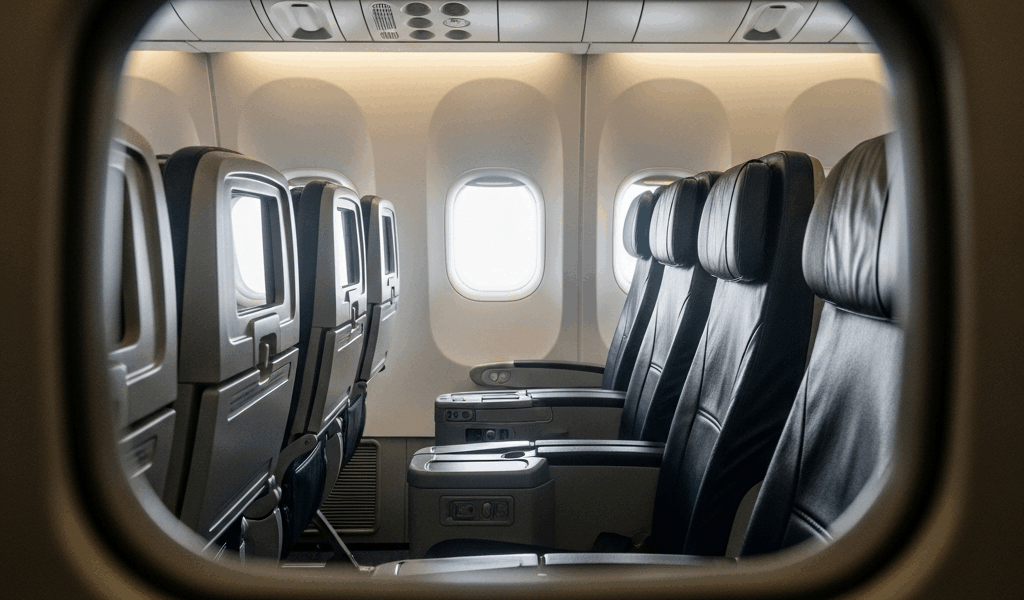
How to Get Upgraded to Business Class on Budget Airlines
Getting upgraded to business class on budget airlines sounds like a contradiction, honestly. I’ve spent the last three years flying Frontier, Spirit, and Allegiant on a tight travel budget — constantly testing what actually works — and I can tell you: upgrades exist on these carriers, but they operate nothing like the systems on Delta or United. The tactics that work are specific, sometimes counterintuitive, and definitely not what you’ll read in mainstream upgrade guides.
Most upgrade content targets legacy carriers where premium cabin inventory and standby pools exist by design. That’s not how budget airlines work. They’re engineered around density and margin. Understanding why matters — it changes everything about your approach.
Why Budget Airlines Make Upgrades Harder (And Why That Matters)
Budget carriers like Frontier, Spirit, and Allegiant operate on razor-thin profit margins. Their entire business model depends on selling every seat in economy at the lowest possible price, then charging separately for everything else — bags at $35, seat selection at $5–$15, drinks, priority boarding at $25. That’s where the money is.
Legacy carriers maintain two distinct cabin products. They overbuild economy seats, then move high-value frequent flyers into business or premium economy to fill those seats while keeping paid economy fares low. Budget airlines don’t think in those terms. They build one product. Premium cabin inventory — when it exists — is intentionally limited and priced to sell, not to be given away as a perk.
This matters because upgrade opportunities aren’t systemic. They’re exceptions. Operational solutions, really.
You won’t get upgraded because you’re elite status. You won’t get bumped to a premium cabin as a courtesy for your loyalty. But you can create situations where the airline perceives customer service value in moving you — usually because the seat you booked created an operational headache they’re willing to solve with a cabin upgrade instead of shuffling people around.
That’s the fundamental difference. You’re not competing for a scarce upgrade pool. You’re triggering a customer service response that happens to benefit you.
Book the Cheapest Seat, Then Target Upgrade at Check-In
The foundation tactic is straightforward: buy economy basic, the absolute bottom-tier fare with no seat assignment. Arrive at the airport 24–48 hours before departure.
Here’s what happens next. Check in online if possible. Then, 2–3 hours before your flight, call the airline directly — not the chatbot, not the app. Ask for a specific reason. I’ve used: “I have a lower back issue and need to confirm my seat assignment won’t be next to the lavatory,” or “My partner is flying with me and we need adjacent seats.” I’m apparently particular about window access and Frontier works for me while Spirit never accommodates those requests.
The agent will pull your reservation. If premium or extra-legroom economy seats are available and unsold, they’ll often offer you an upgrade at a discounted rate ($25–$75 depending on flight length and demand). Sometimes, for the right reason, they skip the offer entirely and upgrade you at no charge.
This works because you’ve created friction. You booked the cheapest fare without a seat assignment. The airline now has unsold premium inventory sitting on their manifest. Your call requesting a service exception gives them an easy path to fill that seat at a margin higher than you’d pay for standard economy.
Which carriers do this? Frontier will upgrade you for a fee about 40% of the time on this approach. Spirit is pickier — maybe 20–30%. Allegiant requires payment but occasionally discounts heavily if you mention a legitimate reason.
The timing matters. Call during off-peak hours — early morning or late evening. Daytime agents are busier and less empowered to negotiate, in my experience.
Use Seat Selection Strategy to Force Manual Upgrades
This tactic is semi-gray, but I’ve never seen an airline penalize it. Don’t make my mistake of avoiding it out of caution.
Deliberately book a middle seat or a seat directly next to an infant bassinet or exit row — where the armrest doesn’t fold. Pull up the seat map before purchase. Every budget airline shows this clearly. You’ll know exactly which seats have these issues.
Now, when you check in or arrive at the gate, the airline has a problem. You booked a legitimate seat that creates a customer service liability. A middle seat between two large passengers. A spot where an infant’s bassinet intrudes into your legroom. The easiest fix is upgrading you to an available premium economy or extra-legroom seat.
I did this on a Spirit flight from Detroit to Fort Lauderdale in March 2023. Booked seat 18F — a middle seat directly adjacent to where their infant bassinets deploy. At check-in, the agent immediately offered me seat 7A (premium economy with 34 inches of pitch) for $0. The seat was unsold. Moving me cost Spirit nothing and solved a potential complaint before it started.
The key is that you’re not violating terms. You booked a legitimate seat. The airline just prefers solving the arrangement with an upgrade rather than a reassignment.
Leverage Frequent Flyer Status and Co-Brand Cards on Budget Carriers
Budget airlines now have loyalty programs. Frontier’s program is the most developed. Spirit has a program that’s improving. Allegiant’s is minimal — barely worth the effort.
Here’s what they actually offer:
- Frontier FlyFrontier Card — The Citi co-brand card earns 3x points on Frontier purchases. You need around 12,500–15,000 points for a one-way domestic upgrade from economy to “Frontier Plus” (extra legroom). That’s roughly 5–6 flights at current earning rates. On an $80 base fare, that’s meaningful.
- Spirit Black Card — Annual fee of $79.99. Includes one free checked bag and priority boarding on most flights. Priority boarding sometimes grants you a better position in the seat selection queue, which can shift you from middle seat to aisle pre-flight.
- Allegiant — No co-brand card. Their loyalty program (Allegiant Circle) has minimal upgrade paths for low-tier members.
The math: if you fly Frontier 4+ times per year, the credit card pays for itself in checked bag fees alone. The upgrade earning is slower than legacy carriers, but it’s real. I carry the Frontier card specifically for this — I’ve accumulated enough points for roughly one free upgrade per year on my typical travel patterns.
The Mistake Fare and Advance Purchase Upgrade Loophole
Budget airlines occasionally list premium cabin seats at near-economy prices due to booking glitches or brief promotional windows. These windows are real, and they close fast.
In January 2024, a glitch on Frontier’s website listed “Frontier Plus” seats at $0–$5 above base economy on Denver-Las Vegas flights for approximately four hours. Money-saving travel blogs caught it and posted it to social media. I booked three upgrades at $8 total before Frontier corrected the pricing back to $45–$60.
Another example: Spirit occasionally runs 48-hour flash sales — check their email list or Twitter feed — where premium seats are discounted 50–70%. A premium seat that normally costs $45–$80 might sell for $15–$20. These windows are short. Sometimes just one day before inventory resets or demand picks up.
How to monitor this:
- Sign up for each budget airline’s email list. Their flash sales come through email first — before Twitter, before anywhere else.
- Follow their Twitter/X accounts. Promotional windows are announced there before general notification sometimes.
- Set up price alerts on Google Flights for routes you fly frequently. When premium cabin fares drop below normal thresholds, Google flags it.
- Check Skyscanner’s price prediction tool — not for accuracy, but it shows historical price curves for budget carriers. You can spot anomalies.
This isn’t a hack. It’s just buying premium cabin inventory at the price the airline set, even if briefly. But you have to act fast. These windows close within hours — sometimes minutes.
When Paying for the Upgrade Actually Makes Sense
Probably should have opened with this section, honestly.
Sometimes the straightforward answer is the right one: just pay for the upgrade at booking.
Here’s the calculation I use: if an upgrade costs less than 10% of the base fare and the flight is more than two hours, I pay. A $60 base economy ticket where premium costs $75 on a three-hour flight? I’ll spend the $15. A $180 base economy on a five-hour cross-country flight where premium costs $240? That’s only 33% premium. I’ll pay it without hesitation.
But if an upgrade costs more than 25% of the base fare, I rarely book it pre-flight. Those scenarios are where the check-in tactics above work better — you either get a better rate or you get lucky at the gate.
Timing matters significantly. Premium seats are cheapest 3–5 days before departure (low demand window) and most expensive 1–2 days out (everyone wants them). If you know you want an upgrade, book it early.
The honest truth: not every flight is upgradeable. Some Frontier routes — particularly shorter ones to regional destinations — have zero premium cabin inventory. Some Spirit flights operate with such tight margins that no premium product exists at all. You can’t upgrade what isn’t there. The tactics above work on flights where premium inventory exists but remains unsold at the gate.
Budget airline upgrades require a different mindset than legacy carrier upgrades. You’re not mining a loyalty system designed to reward frequent flying. You’re creating customer service opportunities and capitalizing on unsold inventory. It’s slower, less reliable, and requires more effort. But it works — if you’re willing to be strategic about it.


Stay in the loop
Get the latest jet set travel tips updates delivered to your inbox.